Non c’è salsa migliore della fame
Lazarillo de Tormes“Non c’è salsa migliore della fame” is Lázaro de Tormes’s whispered answer to his master’s praise of a meal eaten with the appetite of someone who has gone hungry all day. The expression turns deprivation into both seasoning and knowledge: hunger makes scant food taste satisfying, but it also teaches Lázaro how to survive and how to distinguish selfishness from helpless poverty.
Meaning and Immediate Context
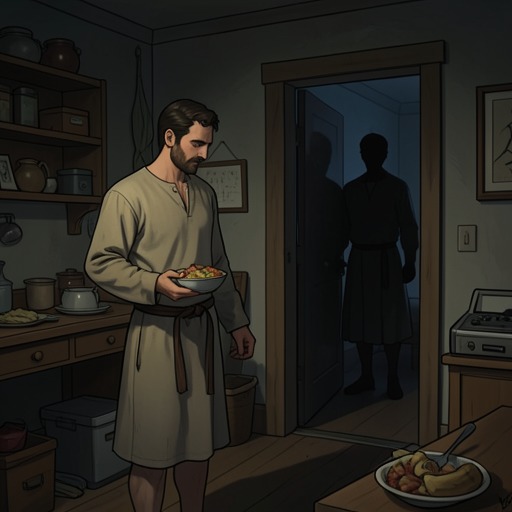
The phrase occurs after Lázaro places a paw and three or four pieces of the whitest bread before his master. The man eats greedily, gnawing each little bone with care, then declares that garlic sauce makes the dish unrivalled. Lázaro replies under his breath that hunger is the better sauce. The master mistakes deprivation for appetite freely indulged; Lázaro’s aside exposes the material condition that makes the poor meal seem delicious.
The scene’s irony depends on the difference between what the master says and what the reader knows. He has not eaten well, and the water jug remains full, evidence that he has had no substantial supper. His satisfaction is real, but its cause is not culinary refinement: it is hunger. Lázaro’s answer is at once a joke, a correction, and an oblique statement of the life that has taught him to make scarcity bearable.
Hunger as Teacher and Survival Strategy
Across Lázaro’s service, hunger repeatedly directs practical ingenuity. Under the blind man, he says that he would have died many times over without his cunning, and describes taking bread, bacon, and sausage from a cloth bundle whose iron ring and padlock the miser guarded closely. He works at an unpicked seam, stealing substantial pieces rather than mere crumbs. The phrase’s wit rests on this harder education: deprivation teaches the servant to find openings that the master’s vigilance cannot entirely close.
The lesson recurs under the priest. Lázaro describes need as a great teacher and says that his constant hunger kept him thinking day and night about how to stay alive. Awake beside the old chest, he waits until the priest sleeps, then uses a knife like a drill at its weakest point to make a hole and reach the bread. He returns to his pallet somewhat consoled, though still so hungry that sleep is difficult. Here hunger is not a figurative seasoning alone; it is the pressure that organizes thought, risk, and action.
Scarcity, Cruelty, and Compassion
The saying also helps distinguish masters who have resources but withhold them from those who have almost nothing. The blind man earns well from his medical claims and advice, yet Lázaro calls him miserly and says that he gave less than half of what the boy needed. The priest likewise keeps the food ration under strict control: five blancas’ worth of meat serves for both lunch and supper, but Lázaro receives only broth and too little bread. On Saturdays, the priest eats the eyes, brain, and flesh around a sheep’s jaws, leaving his servant the picked-over bones.
By contrast, Lázaro’s impoverished squire elicits pity rather than hatred. Lázaro discovers that the man’s velvet purse is limp and has not held even a blanca for a long time. Though Lázaro often brings home food for both of them and sometimes leaves himself barely enough, he sees that his master has nothing and cannot do otherwise. The comparison gives the expression an ethical edge: hunger exposes not only bodily need but the difference between withholding food and having none to give.
From Immediate Hunger to Modest Prosperity
The phrase belongs to a larger progression in which Lázaro’s relation to food changes through work, saving, and self-presentation. As a water seller, he gives his chapel-priest employer thirty maravedís of his daily earnings and keeps the remainder, together with everything he earns on Saturdays. After four years of carefully securing his savings, he can buy second-hand clothes: a fustian jacket, a worn embroidered shirt with slashed sleeves, a once-trimmed cloak, and an old sword. Seeing himself dressed as a respectable man, he tells his employer to take back the donkey because he no longer wants the job.
That later foothold does not erase the earlier hunger. Rather, the contrast shows what the proverb compresses: survival begins with an appetite sharpened by want, passes through ingenuity and labor, and reaches a limited independence measured in retained earnings and clothes. Hunger is therefore both the condition Lázaro resists and the teacher whose lessons shape his movement through service and poverty.